

“I just don’t do consent.”
It is the line from James Howe, husband of leading Australian anti-abortion campaigner Joanna Howe, that has attracted headlines this week. It is the kind of sentence that sounds almost too extraordinary to survive context, except the context actually makes it worse.
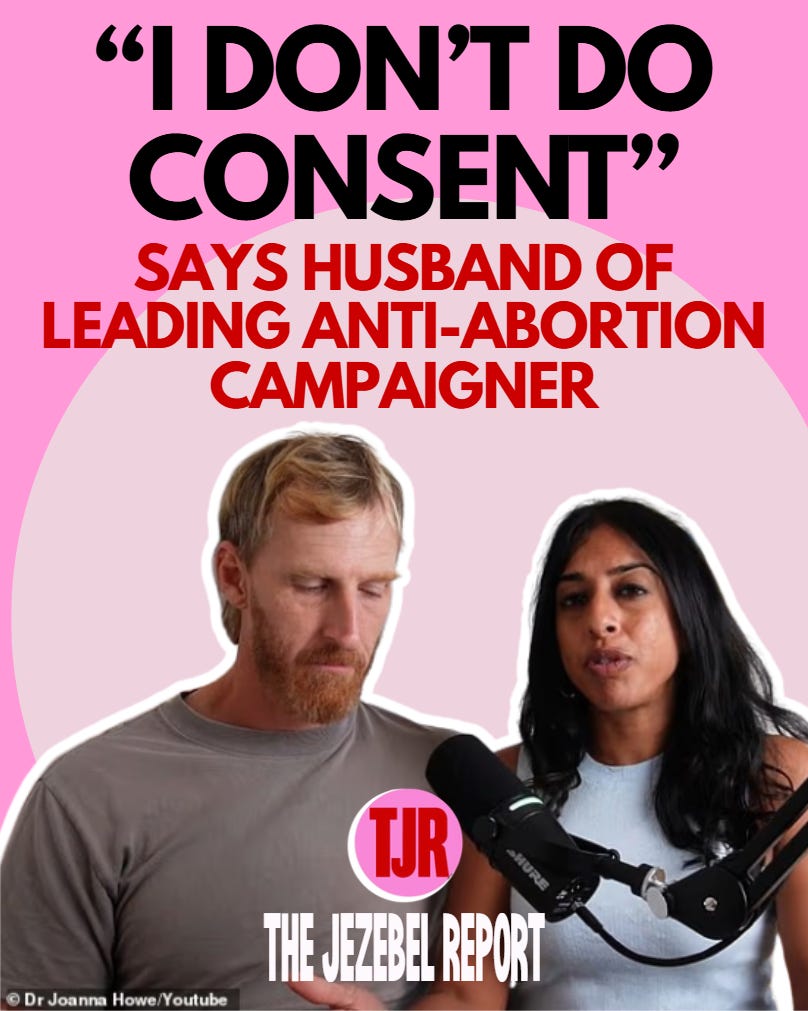
During a September 9 episode of The Dr Jo Show, James and his wife, prominent anti-abortion campaigner Professor Joanna Howe, repeatedly rejected consent as a framework for sexual relationships, presenting marriage as the only alternative. They also mocked the idea of consent education for boys and dismissed sexual pressure as not constituting rape.
The episode, titled The RADICAL Feminist Behind Albanese’s Social Media Crackdown, was principally an attack on Teach Us Consent founder Chanel Contos, and her advocacy on consent education and social-media algorithms.
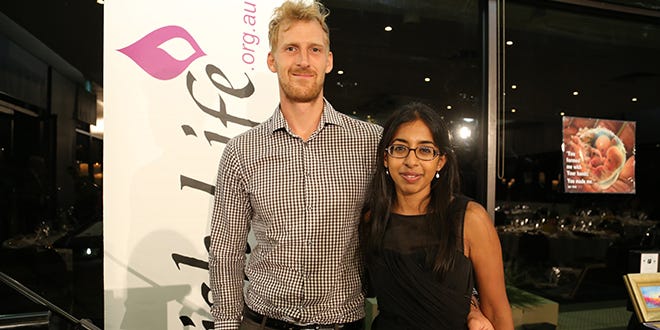
The 9 September podcast also opened with Joanna Howe promoting an anti-abortion rally outside NSW Parliament, scheduled for September 15.
Around half an hour later, the conversation turned from feminism and Contos to sex, marriage and consent.
Joanna Howe describes her own ‘rules’ for when she and James were dating. “Stay public, stay vertical. It’s like, not much can go wrong and, and you know… [Contos] makes it sound like men are just like, waiting to rape you. But if you get really drunk and you go into dark spaces where you’re alone and you don’t know the man very well because you met him on Tinder, you know, or like it’s just—”
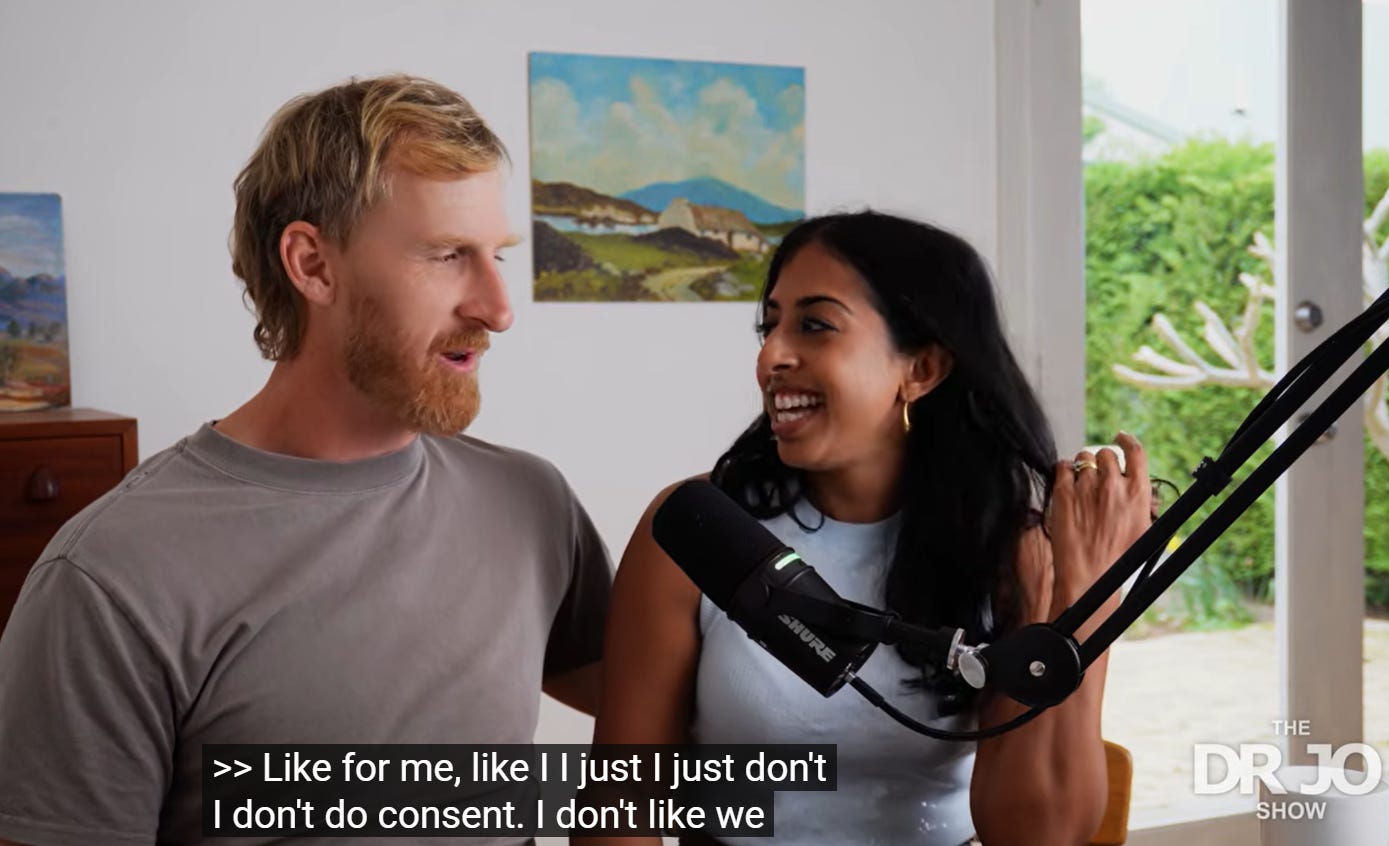
Before she could finish, James interrupted, “Consent is just not a freaking thing. Like for me, like I just—I just don’t—I don’t do consent. I don’t like—we don’t do consent.”
Joanna immediately recognised how the comment would sound, saying through laughter, “They’re going to clip that up online and you’re going to sound really bad.”
In response, Howe said, “But I don’t give a fuck.”
Howe then doubled down. “I do marriage, man. Like I don’t—I don’t do consent!” He mocks in a feminised voice, “Ah, consent! Do you consent?” And later again: “We don’t do consent. We just—we’re just married. Like this is my wife.”
While these comments have since received wider media attention, the full podcast shows the couple went considerably further than the line that has dominated coverage.
‘Consent is not the answer’
Immediately after saying he “doesn’t do consent”, James connected consent education to what he described as the failures of feminism and “free love”.
In an extended monologue, he moved from premarital sex to contraception, abortion and sexual assault: “This is what these feminists have always done, man. They’re like, ‘Free love. Free love. It’s so amazing. Free love. We can have sex with whoever we want.’”
He then mocked the development of contraception: “‘Oh shit, you’re getting pregnant. Oh crap. Well that didn’t work very well. Here, let’s take the pill. Yay! Free love. Free love. Oh shit, we’ve all got diseases. That’s not working. Here, here’s a condom.’”
Howe’s monologue then moved to abortion and rape: “‘Free love. Free love. Oh no. We feel like we’re getting raped. Even if—even if it’s not rape, but we just feel like we’re getting raped because we, you know, we’re getting pressured or whatever. Oh, now we need consent in schools.’”
James concluded: “None of it freaking works. Like none of—have you not figured that out yet? Consent is not the answer. It’s just another—it’s just another fake solution waiting to fail.”
Joanna Howe responded, “that’s right.”
She then argued that when people have sex within marriage and have “chosen [partners] wisely”, then: “you don’t need to talk about consent because you have a good marriage... it’s the only consent that works.”
Marriage is not automatic consent
The comments are notable given Howe’s professional background: she is a Professor of Law at Adelaide University and holds a doctorate in law from the University of Oxford—and yet the discussion bears an uncanny resemblance to one of the oldest legal justifications for marital rape immunity.
For centuries, English common law treated a woman’s marriage as a kind of permanent sexual consent. The doctrine generally associated with English jurist Sir Matthew Hale held that a wife could not withdraw the sexual consent supposedly given through marriage. That principle travelled into Australian law, where for much of our history a man generally could not be prosecuted for raping his wife.
Australian jurisdictions dismantled that immunity through reforms throughout the 1970s to the early 90s.
In South Australia, where the Howes live, the law could hardly be clearer.
Consent is defined through law as freely and voluntarily agreeing to sexual activity, and a person is not presumed to have consented to sexual intercourse simply because they are married to the other person. Rape law also expressly recognises that consent can be withdrawn after sexual activity has begun.
Sexual violence does not stop at the front door of a marriage.
The Howes’ discussion about consent and marriage also points to a broader problem: sexual violence in Australia is not happening primarily between strangers.
ABS data shows that in women’s most recent sexual assault by a male, 53 per cent identified the perpetrator as an intimate partner, and 69 per cent said the assault occurred in a home. Separately, around 618,500 Australian women reported having experienced sexual violence by a cohabiting partner since the age of 15.
Consent is still extremely important inside intimate relationships, and sexual violence does not stop at the front door of a marriage.
The Howes’ anti-abortion and anti-feminist politics
Joanna Howe has gained notoriety as one of Australia’s most prominent anti-abortion campaigners.
She has campaigned for legislative restrictions on abortion in multiple states, organised anti-abortion rallies and spent heavily promoting her campaigns on social media. The ABC reported in July that Howe had spent more than half a million dollars on Facebook and Instagram advertising her anti-abortion agenda since 2020.
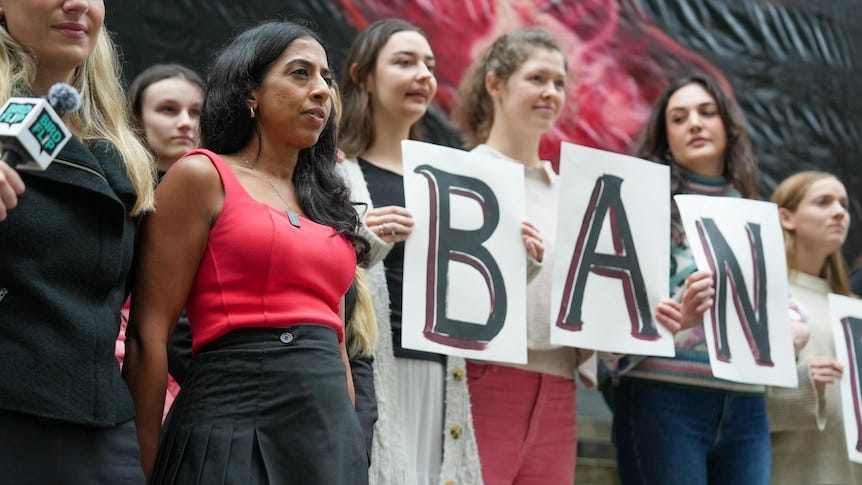
Her husband, James Howe, is also actively involved in that campaigning, and their hostility to contemporary feminism is similarly explicit.
In the September 9 podcast, while discussing Contos’s comments about relationships and women’s careers, Joanna tells her husband: “By that metric, I should be completely screwed because you think feminism is the root of all evil… I used to be, you know, a good little feminist before I met you.”
James responds by criticising the idea that women should judge their success through their careers, and says, “Woke men are honestly the most undesirable, unattractive men.”
This is the ideological framework in which the couple’s later comments about consent sit: sex is presented as properly belonging only within marriage; contemporary feminism is blamed for encouraging women to prioritise career and sexual autonomy; and contraception, abortion and consent education are presented as successive attempts to manage the consequences of sex outside that model.
The Howes’ comments also sit within a field of research examining how religious beliefs, traditional gender roles and “purity culture” can shape attitudes towards sexual violence.
Joanna Howe has publicly identified as a practising Catholic, while she and her husband have both participated in Catholic and Christian events and advocacy.
Several studies have identified associations between particular forms of conservative religious belief and what researchers call ‘rape-myth acceptance’—false or stereotyped beliefs that can minimise sexual violence, blame victims or make coercive experiences less likely to be recognised as rape.
Stronger endorsement of purity-culture beliefs is associated with greater rape-myth acceptance, and a greater likelihood of incorrectly identifying scenarios involving marital rape and acquaintance rape as consensual sex.
A US study involving 653 university students found participants identifying as Roman Catholic or Protestant reported greater rape-myth acceptance than atheist and agnostic participants. Religiosity was also positively associated with rape-myth acceptance after researchers controlled for conservative political ideology.
Another study of predominantly Christian university students found rigid religious fundamentalism was indirectly associated with greater rape-myth acceptance, while a form of religiosity characterised by questioning and exploration was associated with lower acceptance.
Another study into religious purity culture, in which researchers surveyed Christian men and women, found stronger endorsement of purity-culture beliefs was associated with greater rape-myth acceptance, and a greater likelihood of incorrectly identifying scenarios involving marital rape and acquaintance rape as consensual sex.
The Howes’ attack on consent education
As mentioned earlier, the podcast episode was ostensibly an attack on 2023 NSW Young Australian of the Year nominee Chanel Contos, founder of Teach Us Consent, whom the Howes accuse of promoting an inappropriate model of sex education.
Full disclosure: The editor of The Jezebel Report fully supports the work of Teach Us Consent.
The organisation emerged after Contos collected thousands of testimonies from young Australians describing sexual assault and harassment during their school years. Her petition for earlier, age-appropriate consent education attracted around 50,000 signatures and became part of a wider national reckoning over what young people were (and were not) being taught about sex, boundaries and respectful relationships.
In their podcast, the Howes played a clip of Contos discussing the kind of direct language young people can use to establish sexual consent.
“Can I take your top off? Can I kiss you? Can I touch you here?” Contos said. “It’s just so simple. And that is actually exactly how it goes. And I think those conversations need to be explicitly said in classrooms to give children, like, language to be able to use.”
The Howes immediately characterised the comments as a proposal for teachers to conduct sexual role-plays with young children.
“She literally [is] proposing that teachers should be doing this in classrooms,” James said.
The pair then acted out an imaginary lesson involving what James described as “a little boy” and “a little girl in the bathroom”.
“Okay, kids. So, uh, when you, you know, a little boy is talking to a little girl in the bathroom and he says to her, ‘Can I take your top off?’ You know, that’s consent. So, we might practice that.”.
Howe continued the imagined classroom exercise: “So, little boy, can you please say to little Sandy here, ‘Can I take your top off?’ … Okay, Peter, can you please talk to Wendy and say, um, ‘Can I touch you here?’”
The excerpt of Contos played by the Howes did not say teachers should instruct young children to proposition one another, remove clothing or role-play sexual activity. That scenario was introduced by the Howes themselves after the clip ended.
It also bears little resemblance to how age-appropriate consent education is described in Australia’s national framework.
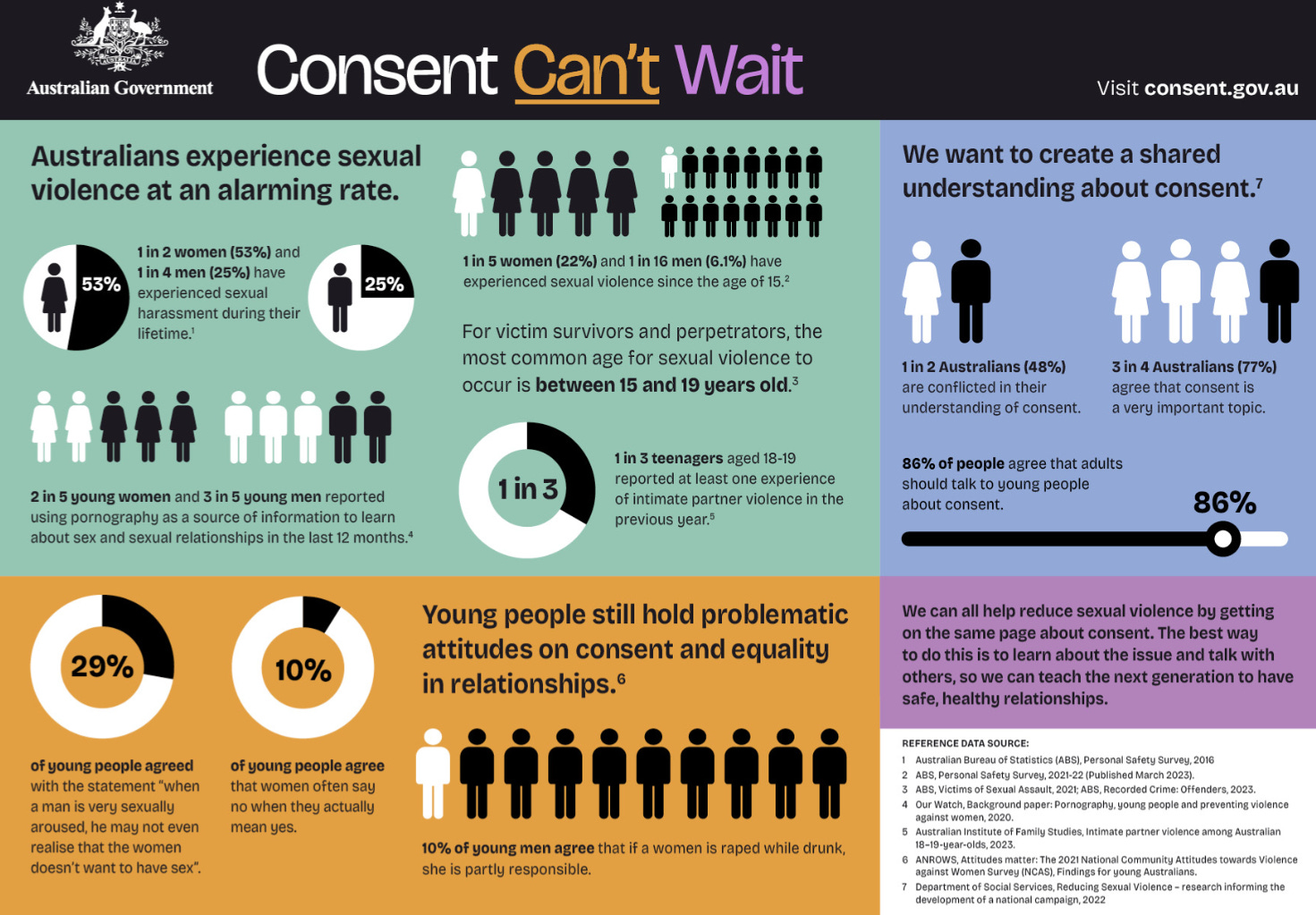
The National Respectful Relationships Education Framework, released in March, requires consent and respectful relationships education to be both age and developmentally appropriate and evidence-based. It specifically states that learning should build progressively as children mature.
For the youngest students, that begins with bodily autonomy and boundaries. The framework says younger cohorts may learn emotional awareness and regulation, while older students progress to subjects including sexual health, relationships and sexual consent.
Mainstream Australian parenting guidance takes the same approach. For younger children, the Raising Children Network recommends teaching simple consent concepts such as: “It’s OK if you don’t want to kiss Aunty Su. Do you want to give her a high-five instead?”
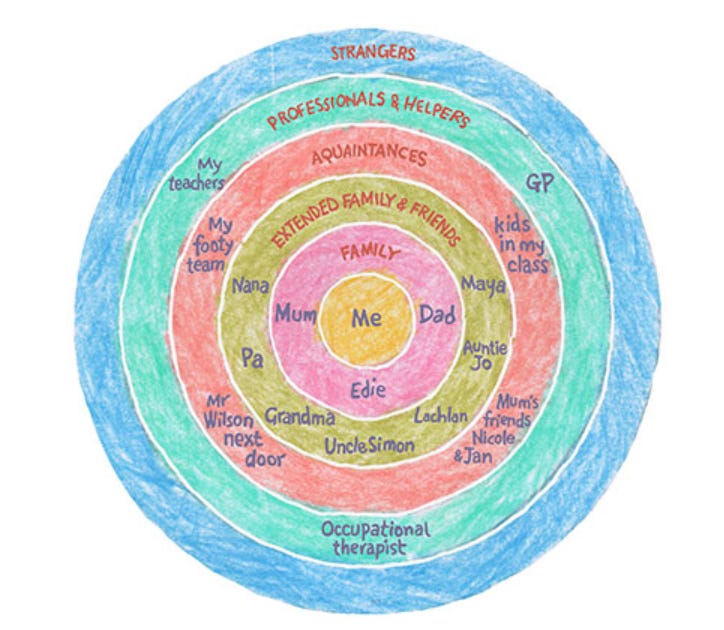
In other words, early consent education does exist—but it does not mean teaching six-year-olds how to negotiate sexual intercourse.
That distinction is particularly relevant because the Howes repeatedly present direct language used with adolescents as though it is being directed at very young children, and describe Contos as a “freak.”
During the episode, Joanna said Contos was contributing to “leftist brainwashing programs” in schools, while the pair referred to consent education as “indoctrination”.
The Howes also made a more specific claim about Teach Us Consent’s government funding.
Joanna said the organisation’s federal funding was “part of rolling out Teach Us Consent across all schools across the entire Australian curriculum”.
Despite the Howes claiming Teach Us Consent received $3.5 million to effectively march into classrooms and deliver this material, the Commonwealth’s funding announcement says the $3.5 million grant was designed to develop and distribute social media resources on consent, particularly for young people aged 16 and over.
The Commonwealth also records the program separately from school-based consent and respectful relationships education measures.
The federal government’s actual school-based Consent and Respectful Relationships Education program is funded separately, with $77.6 million provided to states, territories and non-government school sectors to support schools delivering age-appropriate programs tailored to their communities.
The Howes’ broader argument relies heavily on the idea that Contos has been personally handed millions of dollars to determine what teachers say to children in Australian classrooms. The government’s own documents do not support that characterisation.
The other fight: social media algorithms
At the same time the Howes campaign against abortion and consent education, they are also opposing proposed regulation of the online systems that researchers say are exposing boys to misogynistic content.
Joanna Howe has described Labor’s proposed Digital Duty of Care as a “censorship regime” and accused supporters of manufacturing a “misogyny crisis” to justify government control. Her podcast has specifically attacked Contos’s Fix Our Feeds campaign.
Algorithm recommender systems often push harmful material towards young men.
However, the research on what boys are encountering online is becoming extremely difficult to ignore.
Australian eSafety research found that algorithm recommender systems often push harmful material towards young men, and that misogynistic communities and creators attract young men by offering belonging, validation, advice and certainty.
Among Australian children aged 10 to 17, almost half have encountered offensive, sexist or hurtful material about girls or women online. More than one in ten have encountered violent sexual imagery.
A major Monash University survey released just weeks ago found 78 per cent of more than 2,600 teachers had observed or experienced sexism or misogyny in schools. Half reported an increase in gendered violence among students. Seventy per cent had noticed manosphere ideas influencing student attitudes or behaviour in the previous year.
One of the most confronting experimental studies comes from Dublin City University’s Anti-Bullying Centre, where researchers created accounts resembling teenage boys on TikTok and YouTube Shorts. All were served toxic material within 23 minutes, including accounts that had not gone looking for manosphere content. Once the accounts engaged with that material, the recommendations rapidly intensified; after a few hours, around three-quarters of recommended content in the final stage was classified as problematic or toxic.
If you are genuinely worried about children learning unhealthy ideas about sex, why would you reserve so much fury for consent educators, and comparatively little for billion-dollar platforms algorithmically feeding boys violent pornography, misogyny and male-supremacist content?
This is what Chanel Contos is talking about—not banning boys from having opinions or hypnotising them into feminism. She has advocated for making personalised recommendation algorithms opt-in, so that a 16-year-old arriving on social media is not automatically placed inside an engagement machine that learns what makes him angry and serves him more of it.
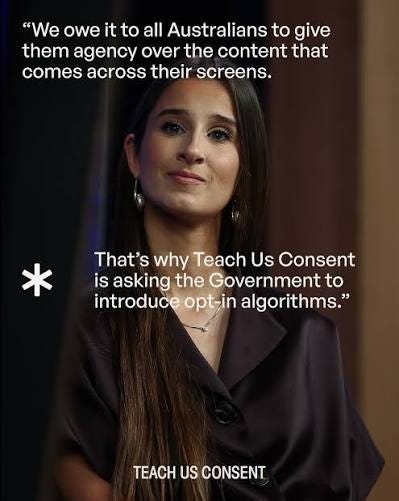
The Albanese government’s draft does not perfectly replicate Contos’ proposal, but its “My Feed, My Way” model would require platforms to give users over 16 a choice between personalised algorithmic recommendations and a feed based on the accounts they actually chose to follow. The broader Digital Duty of Care would also require platforms to take reasonable steps to protect children from specified serious harms.
This raises a significant question for the Howes: If you are genuinely worried about children learning unhealthy ideas about sex, why would you reserve so much fury for consent educators, and comparatively little for billion-dollar platforms algorithmically feeding boys violent pornography, misogyny and male-supremacist content?
The Howes’ worldview seems to be one that places extraordinary faith in the institution of marriage, while treating many of the tools designed to protect women’s autonomy outside it—contraception, abortion, feminism and consent education—with suspicion or contempt.
A wife is not the property of her husband, and marriage does not amount to ongoing consent to sex. A woman retains the right to refuse sexual activity, withdraw consent and make decisions about her own body after marriage just as she did before it.
The Howes’ worldview places extraordinary faith in the institution of marriage, while treating many of the tools designed to protect women’s autonomy outside it—contraception, abortion, feminism and consent education—with suspicion or contempt.
A wife is not the property of her husband, and marriage does not amount to ongoing consent to sex. A woman retains the right to refuse sexual activity, withdraw consent and make decisions about her own body after marriage just as she did before it.
As a professor of law, Howe would be well aware that modern consent laws do not treat marriage, relationships or previous sexual activity as blanket permission for future sex. Consent must exist at the time of the sexual activity in question, no matter the relationship status—and it can be withdrawn.
There is a straight line running through all of these debates—abortion, purity, sex education, feminism, marriage and consent. At its centre is the same question: who gets the final say over a woman’s body?
For feminists, that question has been fought over for generations. The answer is the same one that reshaped laws around marital rape and sexual consent: the woman herself.
The Jezebel Report contacted Joanna and James Howe for comment. Neither responded by publication.
Reported and written by Samantha Blok for The Jezebel Report.
The Jezebel Report is an independent feminist publication investigating faith, power, purity culture and church accountability.
Have information, documents or experiences relevant to this investigation? You can contact Samantha confidentially.
Follow The Jezebel Report on Instagram @thejezebelreport and on Facebook
Follow Samantha Blok on Instagram @samanthablok_ and on Facebook
Support is available:
If you or someone you know is experiencing, or at risk of experiencing, domestic, family or sexual violence, contact 1800RESPECT on 1800 737 732, text 0458 737 732, or access online chat at 1800RESPECT. Services are available 24 hours a day, seven days a week. If you are in immediate danger, call 000.
This is awful. How the hell is Joanna Howe a highly educated lawyer? I am a lawyer and an exvangelical and the views of these people are so incredibly harmful. Even if they think they don't need consent because they have a 'good marriage' what about abusive marriages? I guess it will be the woman's fault again, must not have submitted well enough. Just awful.